
 Kick Start Your Accounting Journey, We Help You to Start from Scratch
Zoho Books vs Zoho ERP
The feature is not the only consideration when choosing business software. It concerns the appropriate level of control, automation, and the size of your business. This is where most businesses fail to differentiate between Zoho Books and Zoho ERP.
Both are constructed for different purposes, though at first glance they appear to be the same ecosystem. Zoho Books is primarily a financial management and accounting-based system and whereas Zoho ERP is an operations-based system, which has combined finance, purchase, payroll, projects, inventory, the Customer Relationship Manager and other business processes all on a single platform. Other related suites provided by Zoho include Zoho Finance Suite/Finance Plus and inventory modules, which can be used to expand accounting into operations.
What Is Zoho Books?
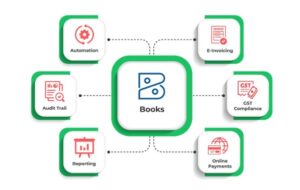
Zoho Books is a web-based accounting software which helps businesses manage invoicing, expenses, banking, reporting taxes and daily accounting. It is also available with invoice automation, payment reminders, bank feeds, an audit trail, and workflows required to satisfy tax obligations and does not require integration with a comprehensive ERP system which makes it a a suitable choice for startups and small to mid-sized companies. (Zoho)
Zoho Books would be optimal when you are primarily worried about:
- Sending invoices fast
- Following up on revenue and costs.
- Reconciling the bank transactions.
- Managing compliance and taxes.
- Producing accounting reports
- Generating accounting literature.
What Is Zoho ERP?
Zoho ERP is not just an accounting tool; it is an ERP stack designed to assist businesses in managing broader operations, where interconnected systems are integrated to manage payroll, finance, and all other business activities. Practically, this implies that Zoho ERP is more appropriate to use by businesses that require a single and unified deployment in various departments but not just a financial solution.
Depending on the business model, a Zoho ERP setup may involve multiple Zoho products working together, including finance apps, inventory management, HR, CRM, low-code custom workflows in Zoho Creator, and industry-specific configurations.
Zoho Books vs Zoho ERP: The Core Difference
The most significant difference is in scope.
- Zoho Books is suitable for accounting-focused businesses.
- Zoho ERP is suitable for operations-focused businesses that require finance and process control among the departments.
Think of it this way:
If you want to manage your books, invoices, taxes, and payments, Zoho Books should be sufficient.
If you require procurement management, payroll, stock flow, approvals, visibility between teams, and custom workflows along with the finance, Zoho ERP would be more appropriate.
When Zoho Books is the preferable choice:
The Zoho Books would be the correct option, when your focus on operations is limited, when your business needs clarity about financial performance.
When Zoho Books Is the Better Choice
Zoho Books is the smarter option if your business is still focused on financial clarity more than operational complexity.
It works well for:
- startups
- service businesses
- agencies
- consultants
- freelancers
- small retailers with straightforward accounting needs
It comes in handy in particular when you need quicker implementation, a lower learning curve, and a simpler process. Another advantage of Zoho Books is that it is highly integrated with the Zoho ecosystem, so businesses can still integrate it with other tools where necessary.
When Zoho ERP Is the Better Choice
When you are not just an accounting business anymore, Zoho ERP is the better choice.
It is better adapted when you require:
- Multi-department coordination
- Comprehensive purchase management.
- Payroll integration
- Larger inventory workflows
- Multi-step approvals
- Internal applications that are custom-built.
- Increased visibility on operations.
As an illustration, a trading firm, manufacturer, distributor, or growing business can require additional elements than invoices and reports. It may come with associated purchases, stock tracking, supplier tracking and role-based procurement processes. That is where a more extensive ERP implementation will be more useful. This broader approach is supported by Zoho ERP’s positioning and its low-code platform.
Which One Should You Choose?
Select Zoho Books when you want simplicity, faster deployment, and powerful accounting capabilities.
Select Zoho ERP if you want a single system that can manage finance and the entire business process.
A good rule is this:
- Begin with Zoho Books in case your pain point is accounting.
- Head to Zoho ERP if operational complexity is the pain point.
Final Thoughts
It is not a competition of which one is the better in general between Zoho Books vs Zoho ERP. It depends on what best suits your business needs.
Zoho Books is best suited for businesses with business requirements that do not require any complexity in their accounting and tax organization, invoicing, and reporting. Zoho ERP is a more comprehensive business solution to organizations seeking to tie together finance and operations, inventory management, payroll, purchasing, and custom workflows.
This is because the best option depends on the type of tool your business requires, whether finance tool or a full business management tool.